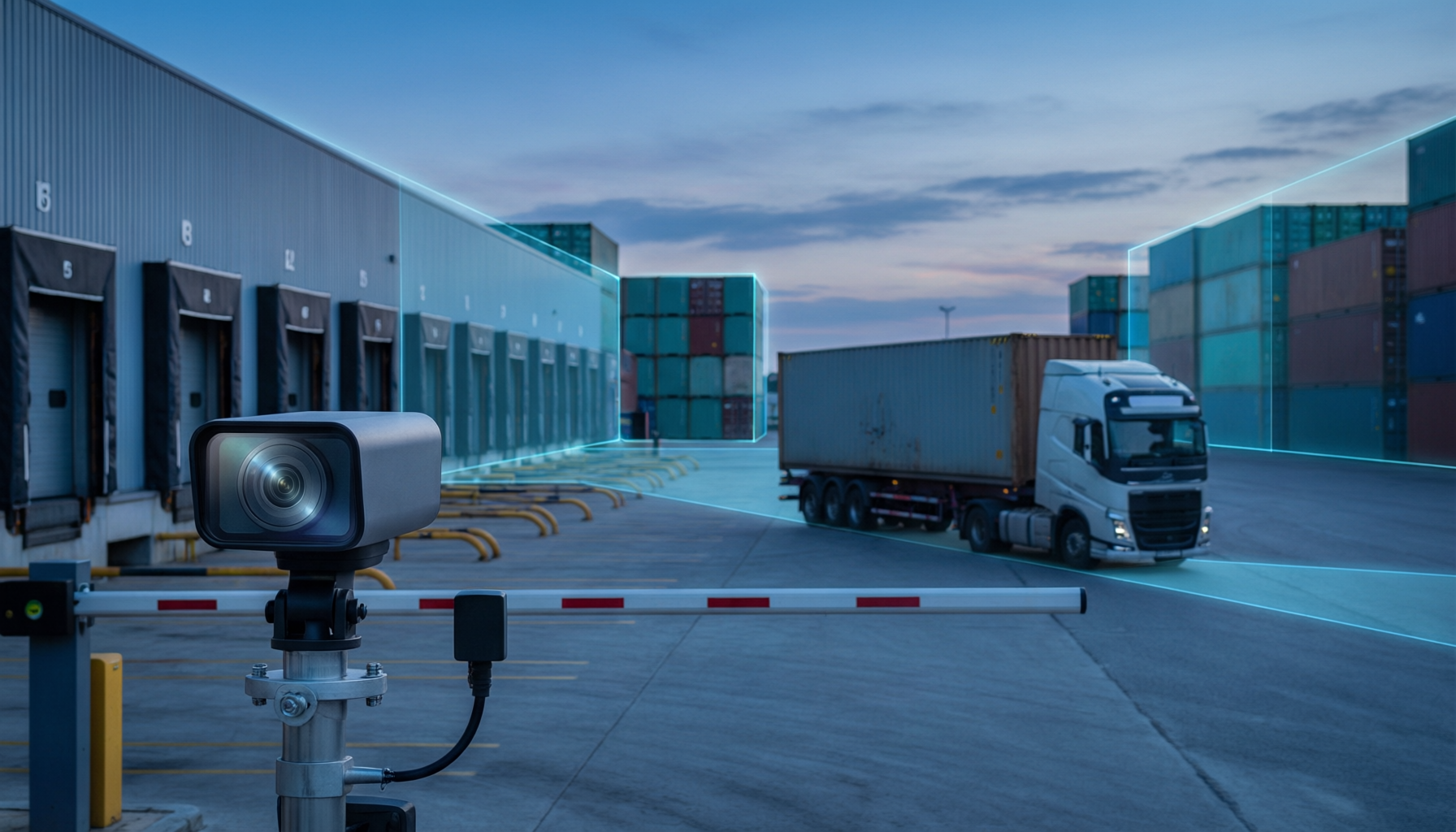
A trailer sits an average of 3.8 hours at a distribution centre dock, and 22% of trailers exceed the two-hour free window — costing a mid-sized US operation around USD 180,000 a year in detention fees alone. The bottleneck is rarely the forklift or the WMS — it is the gate, where someone reads a plate, matches it to an appointment and confirms the container number. AI vision compresses that to a sub-second decision.
Executive Summary
AI vision has moved from warehouse pilots to gate, yard and dock infrastructure, and the economics now rest on dwell time, not camera cost. The AI-in-logistics-automation segment grows from USD 12.29 billion in 2025 to USD 53.14 billion in 2030 at a 34.1% CAGR, while warehouse automation passes USD 29.30 billion in 2026. Detention and excessive dwell cost the US trucking industry about USD 3 billion annually, and AI-orchestrated dock scheduling claims dwell reductions of 40% or more. The question is no longer whether to instrument the gate, but whether the readings are accurate enough to run unattended. Entity tags: AI vision | logistics | warehouse automation | yard management | ANPR | container identification | Southeast Asia | 2026
The Current State of AI Vision in Logistics Operations
Logistics automated the inside of the warehouse far faster than the outside. The logistics automation market was USD 44.0 billion in 2025, reaches USD 50.1 billion in 2026 and is projected at USD 148.7 billion by 2033, a 16.8% CAGR, with inventory and storage management the fastest-growing segment (Grand View Research, 2026). Warehouse automation alone goes from USD 25.27 billion in 2025 to USD 29.30 billion in 2026 (Precedence Research, 2026).
The yard is the laggard, and where the money leaks. Detention and dwell cost the US trucking industry roughly USD 3 billion a year, with trailers averaging 3.8 hours on site and 22% overrunning the two-hour free window (CX TMS, 2026). That is not a visibility gap — the truck is already on camera. It is an interpretation gap: nothing turns footage into an appointment match, a dwell clock and an exception.
Closing it is why the AI-in-logistics segment compounds at 34.1% to 2030 (The Business Research Company, 2026). A gate camera that reads plates can also identify containers — work already proven in automated container identification and gate-grade ANPR.
How AI Vision Performance in Logistics Is Measured
Read rate is the first number, and it is not one number. Plate read rate and container-number read rate fail differently under dirt, glare and damaged ISO codes. Match rate is the share of gate events tied to an appointment; 99% read with 70% match still leaves three trucks in ten handled manually. Dwell time, gate-in to gate-out, is the outcome, and dock utilisation converts it into capacity. Exception rate per 1,000 movements is the honest labour metric, because each unmatched event becomes a phone call. Latency decides whether the barrier opens on approach. Benchmarks only count once re-measured on your own gate — the discipline in our AI vision ROI benchmarks.
Industry Evidence: 2026 Logistics Vision Benchmarks
Dwell: AI-driven dock scheduling reports reductions of 40% or more, with detention savings approaching six figures annually for mid-sized operations (CX TMS, 2026). Detention baseline: trailers average 3.8 hours on site, 22% overrun the free window, and a mid-sized facility pays roughly USD 180,000 a year in detention charges. Market pull: AI in logistics automation grows from USD 12.29 billion in 2025 to USD 16.45 billion in 2026, reaching USD 53.14 billion by 2030 at a 34.1% CAGR (The Business Research Company, 2026). Automation base: logistics automation reaches USD 50.1 billion in 2026 on a 16.8% CAGR to USD 148.7 billion by 2033, with North America at 35.4% of 2025 revenue and Asia Pacific fastest-growing (Grand View Research, 2026). Deployment economics: a first production vision line costs USD 150,000–250,000, extra lines USD 30,000–50,000, and edge inference — now over 50% of new deployments — runs 4–7x cheaper than cloud GPU inference over three years (Datature, 2026 Enterprise Vision AI Adoption Report).
Comparative Analysis: AI Vision vs Manual Gate & Yard Checkpoints
| Metric | Manual gate process | AI vision gate |
|---|---|---|
| Plate / container read | 85–95% human-read accuracy | 97–99% on calibrated lanes |
| Average trailer dwell | 3.8 hours | 40%+ reduction reported |
| Appointments matched automatically | Typically none — phone or clipboard | 90%+ with WMS/TMS integration |
| Detention exposure, mid-size site | ~USD 180,000 per year | Materially reduced, exception-driven |
| Gate processing time per truck | 2–5 minutes, driver-dependent | Seconds, no driver interaction |
| Staffing per gate lane | 1–2 people per shift | 0 at the lane, 0.2 in exception review |
| Overnight and peak coverage | Degrades with fatigue | Flat accuracy |
| Audit trail | Paper, photo if lucky | Timestamped image and event record per movement |
Best Practices & Recommendations
- Instrument the gate before the yard. One calibrated lane with plate, container and trailer-type recognition produces the events every yard metric depends on.
- Set match rate, not read rate, as the acceptance criterion. A reading that never joins an appointment has removed no labour.
- Reconcile against the TMS from day one. Dwell clocks must come from the records finance bills against, or disputes replace phone calls.
- Run unattended, review by exception. Fix a target exception rate per 1,000 movements and staff to it.
- Reuse the camera layer for safety. Gate masts also see PPE compliance, unauthorised entry and seal integrity — the consolidation case is in our AI vision ROI analysis.
Limitations & Considerations
Gate vision is bounded by geometry and weather. Damaged plates, stacked containers outside the field of view and oblique approach angles cut read rates, and pilot-lane results rarely survive a rainy night shift without re-tuning. Dwell gains are also partly process change: if appointments are still booked by phone, software alone moves nothing. Integration is the usual overrun — WMS and TMS vendors expose appointment data inconsistently, and older yard systems may have no API. Continuous gate video is personal data, so retention, access controls and PDPA obligations in Malaysia and Singapore belong in the design, not the retrofit.
Frequently Asked Questions
Q: Can AI vision read container numbers as reliably as licence plates? A: Not on every lane, and the gap matters operationally. ISO 6346 container codes are vertical, often dirty and frequently damaged, so a gate designed for plate-level accuracy will generate exceptions. Multi-camera lanes with dedicated container OCR reach usable read rates, but plan a manual fallback for obscured codes and measure container read rate separately from plate read rate.
Q: How much does AI vision at a warehouse gate cost? A: A first production deployment — cameras, edge hardware, model work and integration — typically runs USD 150,000 to 250,000, with additional lanes at USD 30,000 to 50,000 each, according to 2026 enterprise vision adoption data. Edge inference is the default because it costs roughly four to seven times less than cloud GPU processing over three years and keeps gate decisions local when connectivity drops.
Q: Does dock scheduling AI actually reduce trailer dwell time? A: Vendors report dwell reductions of 40% or more, and the mechanism is credible: the largest contributor to dwell is a truck arriving against a dock that is not ready, which appointment orchestration and live yard state directly address. Treat 40% as an upper bound achieved where scheduling, gate automation and yard visibility are deployed together — not as something one module delivers alone.
Q: What accuracy should we require before running a gate unattended? A: Set the bar on match rate against your TMS and on exception volume per 1,000 movements, then set read-rate thresholds to serve them. In practice, lanes need sustained plate read rates in the high nineties across day, night and wet conditions before staffing comes out, and acceptance should run two weeks of real traffic, not a single shift.
The Bottom Line: Measure the Gate, Then the Yard
The warehouse is already automated; the fifty metres outside it usually are not. Trailers average 3.8 hours on site, 22% breach the free window, and the US industry absorbs about USD 3 billion in detention a year — while logistics automation compounds at 16.8% toward USD 148.7 billion by 2033. AI vision earns its place at the gate by turning existing footage into appointment-matched events and a billable dwell clock. Start with one calibrated lane, hold it to match rate rather than read rate, and staff to exceptions. Request a demo →
Sources: Grand View Research, Logistics Automation Market (2026) · Precedence Research, Warehouse Automation Market (2026) · The Business Research Company, AI in Logistics Automation Market (2026) · CX TMS, Yard Management & AI Dock Scheduling Dwell Times (2026) · Datature, Enterprise Vision AI Adoption Report (2026)