Physical retail is undergoing its biggest transformation since the barcode. In 2026, AI video analytics has moved from experimental pilots to boardroom priority — with the global AI-in-retail market reaching $20 billion and over 90% of retailers actively evaluating computer vision technologies. The stores that win are no longer the ones with the best locations. They are the ones with the best data.
- AI video analytics runs on existing CCTV cameras and edge processors, so no new hardware is needed.
- Retailers report 45% conversion uplift after optimizing store layouts with footfall and heatmap data.
- Real-time queue alerts cut wait times by 34% and recovered $120K in abandoned-cart revenue per store.
- AI loss prevention delivers 25-40% shrinkage reduction within six months of deployment.
Why AI Video Analytics in Retail Matters Now
Three converging forces drive this shift: existing CCTV infrastructure provides ready cameras, edge AI processors now run vision models affordably, and consumer expectations demand the same intelligence in physical stores.
What Is AI Video Analytics in Retail?
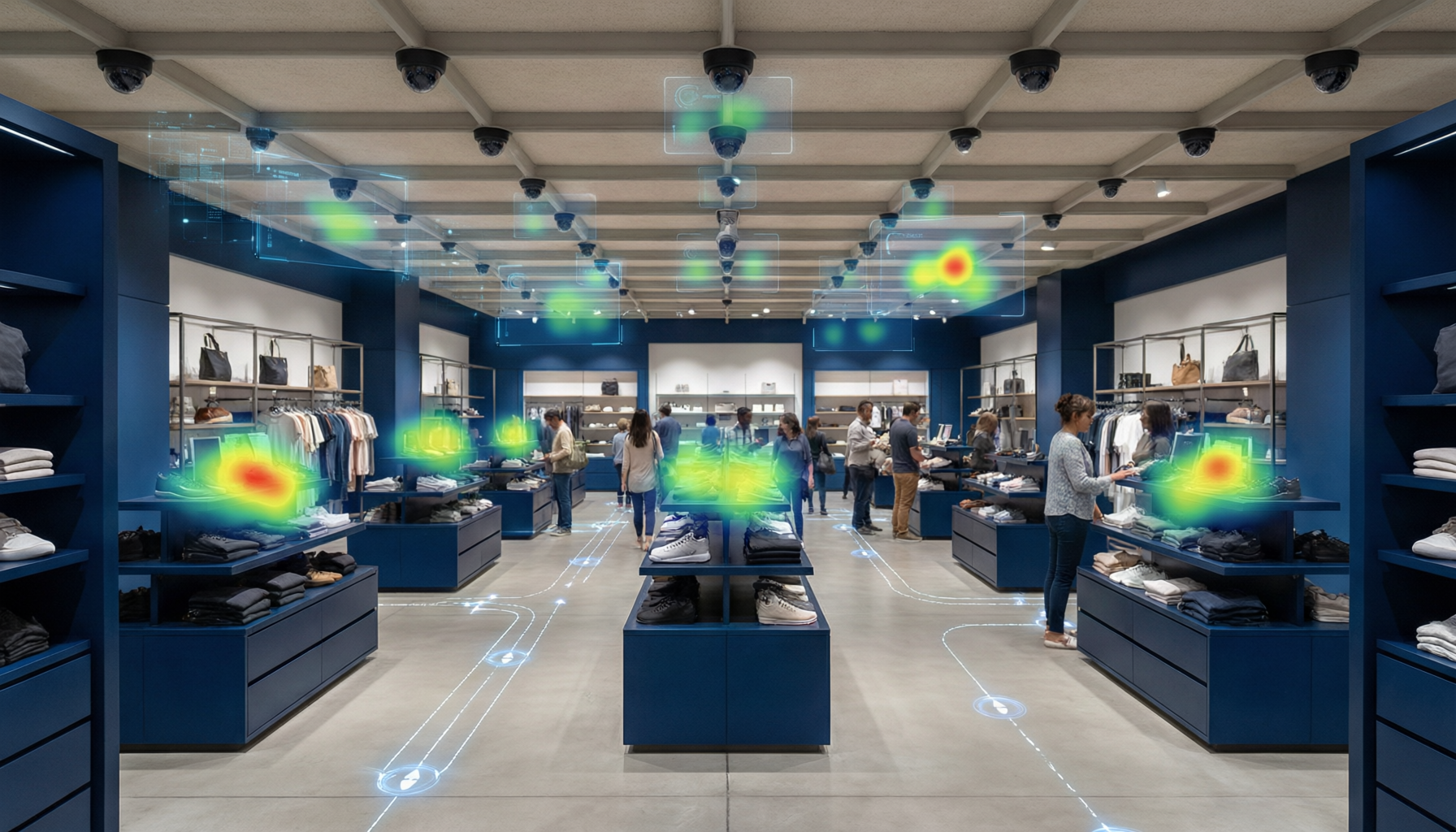
AI video analytics applies computer vision to existing CCTV feeds to measure and optimize every dimension of physical retail. Unlike traditional people counters, AI-powered systems understand what happens between the door and the register.
How It Works
(1) Video Capture — Existing IP cameras feed into an edge AI processor. No new hardware needed.
(2) AI Detection & Tracking — Deep learning models detect and track shoppers anonymously, measuring footfall, paths, and dwell time.
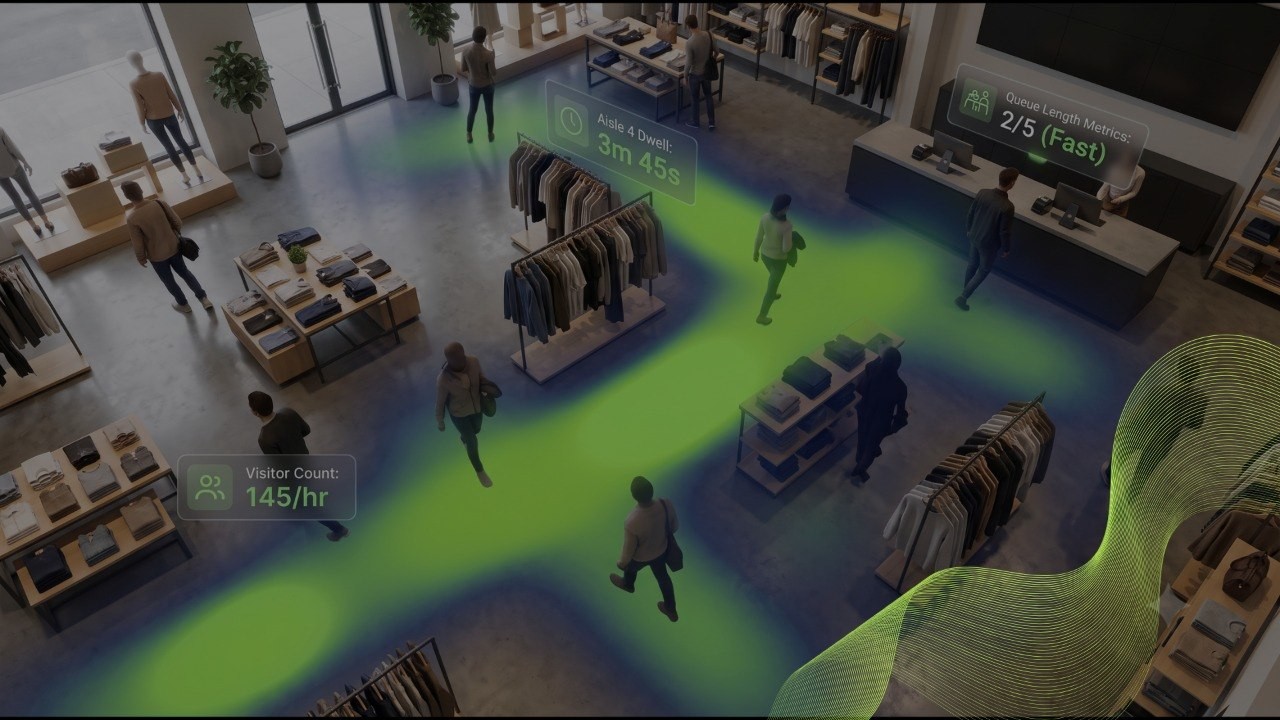
(3) Real-Time Analytics — A dashboard shows live footfall, heatmaps, queue depth, and zone occupancy.
(4) Actionable Insights — Patterns become operational decisions: restaffing, layout changes, promotional placement.
Key Benefits of AI Video Analytics in Retail
Retailers deploying AI video analytics report measurable improvements across multiple dimensions:
Use Case 1 — Footfall Analytics & Customer Journey Mapping
AI transforms the store into a measurable funnel. Retailers report 45% improvement in conversion rates after optimizing layouts based on movement data. Heatmaps reveal which displays attract attention, enabling data-driven merchandising that impacts revenue per square foot.
Use Case 2 — Queue Management & Staff Optimization
Real-time queue alerts enable dynamic staff redeployment. One supermarket chain reduced wait times by 34% and recovered $120K in abandoned-cart revenue per store annually.
Use Case 3 — Loss Prevention & Shrinkage Reduction
AI vision systems detect suspicious behavior and alert staff in real-time. Early adopters report 25–40% reduction in shrinkage within six months, with staff spending more time serving customers.
AI Video Analytics in Retail: Industry Data & Stats
$15.4B → $20B → $57B — The AI-in-retail market grew from $15.4 billion in 2025 to $20 billion in 2026, with projections reaching $57 billion by 2030 (The Business Research Company, 2026). 90%+ adoption — Retailers using or evaluating AI (Quantumrun, 2026). 45% conversion uplift from footfall analytics (Agrex AI, 2026). 25–40% shrinkage reduction with AI-powered loss prevention in the first six months.
How Tapway Helps
Tapway SamurAI Vision brings enterprise-grade AI video analytics to retail stores using existing cameras. Edge-AI processes video locally — no cloud uploads, no bandwidth costs. Deployment takes under a day, delivering real-time footfall, heatmaps, queue alerts, and conversion metrics. With clients across Malaysia and Southeast Asia, the platform scales from a single boutique to 100+ store networks.
Real Results
Tapway clients achieve accurate multi-entrance footfall tracking and data-driven layout optimizations. One mall operator increased tenant retention by using footfall analytics as a leasing tool.
Getting Started
Most deployments use your existing IP cameras. Start with a pilot: one store, one month, measurable metrics. Request a demo
AI Vision in Southeast Asia: $25.7B Market by 2030
August 3, 2026
How AI Video Analytics Are Transforming Physical Retail
July 30, 2026
How Does Fruit Grading Automation Work with Computer Vision?
July 28, 2026
The ROI of AI Vision: 2026 Industry Benchmarks & Statistics
July 23, 2026